Grid Metering

Grid Metering Solutions are required by the utilities to collect data from all energy exchange points through special energy meters. Kalkitech Grid metering system helps the utilities to automatically read the data, remotely configure the system, collect load data and further manage, process and analyze the gathered data to produce the required reports and graphs. This solution provides the utility with significant cost savings in the area of outage management, revenue protection and asset management.
Support Documents
Forward looking utilities across the globe understands the need and benefit of getting real time data and analytics for monitoring of instantaneous parameters and events / outage, improving their energy accounting, asset and revenue management. The current system in place could be a manual / proprietary meter data acquisition that might have issues with respect to accuracy, speed, security and scalability.
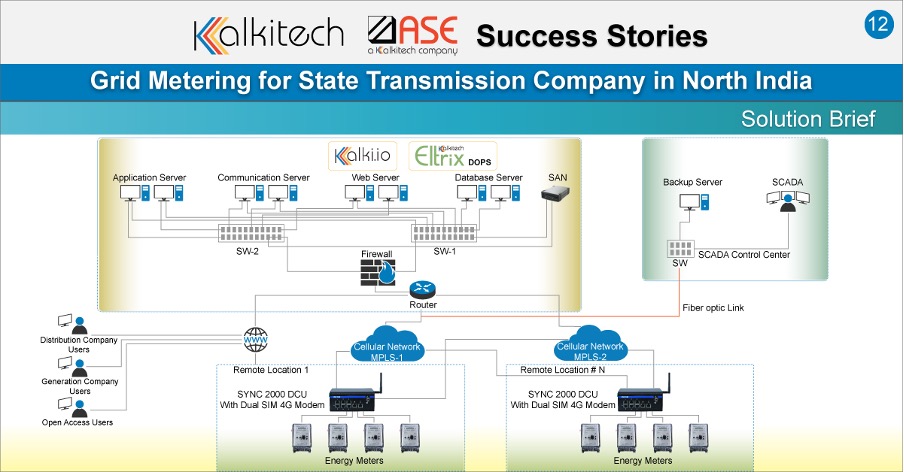
Grid metering solution by Kalkitech develops on the existing infrastructure with minimal and efficient upgradation of the current system as and where required. In a typical solution, the energy exchange points in a grid are metered. The metering data within a substation will be collected / concentrated using a substation DCU (Data Collection Unit – Kalkitech SYNC 25xx) and sent to the main control centre CDCS (Central Data Collection System). The CDCS is typically a combination of software and hardware including Meter data collection software (Kalkitech SYNC 5xxx– MDAS) .
SYNC MDAS (Meter Data Acquisition System) collects the data from meter through the DCU on various protocols / format, stores it temporarily in the database and sends it across to high end systems like Meter Data Management System and billing and settlement systems. The MDAS software has got mainly three modules called Meter Reading Module (MRM), Data Storage Module and Data Delivery Module. MRM supports various standard metering protocol and meter specific adapters for data collection. Data delivery module supports various standard adapters like IEC 61968-6 webservice, IEEMA MIOS CDF format, DLMS and proprietary file formats like ASCII, CSV, XML and many more.
The DCU might also be connected directly through a station LAN to the local control centre for generating locally required reports as well. The downstream communication of the DCU to the meters could be through an RS 485 multidrop, or through interface connectors (where only optical ports are available on the meter) or even through RF. For meters that do not support modern communication systems, they can even opt for MIC / MIU like Kalkitech SYNC MIC 6xx / 15xx that helps enable the meter to communicate in RF / PLC / Zigbee. The upstream communication of the DCU to the MDAS could be through channels like Fibre Optic cables, PSTN, GPRS, CDMA, GSM based on the utilities existing infrastructure and availability. The MRM of the DCU can talk and understand all major metering protocols like DLMS / COSEM (IEC 62056), ANSI C12.18 and IEC 1107 and has high EMC / EMI capabilities as well.
The data sent by the DCU is received by the control centre M2M gateway or a front end processor (FEP – Kalkitech SYNC 4000) that routes the data to the MDAS. The M2M Gateway creates VPN between the central location and the distributed DCUs at different substations. It typically has a built in firewall and also assigns static IP address to the devices there by eliminating the requirement of a private APN. DCU will read the energy and process / status data from the energy meter periodically or on-demand (requested by CDCS) and transfer to CDCS on the selected network. CDCS will process / validate data and store in database for later use by other billing / EA / ABT softwares like Kalkitech ELTRIX.
System Components Standard
- Server System and CDCS at Main Control Centre along with MDAS .
- Meter Data Mangement Software (Optional)
- Data Concentrator Unit (DCU)
- Supply of Interface Convertor Unit (ICU) wherever required
- Network Hardware and Cables
- GSM / GPRS / PSTN Modems
- Standard database (RDMS) for storage of data at Central Control Centre
- Normalized structure of database
The Grid Metering architecture:


Some of the key benefits of implementing Kalkitech's Grid Metering Solution includes:
- Input for utility revenue management and energy accounting
- DCU can serve instantaneous meter data to SCADA
- Combine with multiple functionalities like Disturbance Record collection from protection relays, remote configuration of substation devices, remote asset status monitoring
- Time drift correction
- Compatibility with OPGW, GPRS, CDMA, VSAT, MLLN based communication
- SMS based configuration of remote devices
- Realtime Event Notification via e-mail or SMS
- IEC61870 CIM / XML based standard interfaces to external enterprise applications
- Interoperability with multiple vendor meters
- Supports open standards such as DLMS / COSEM, MIOS, IEC61850, DNP3, ANSI C12.18/19
- Supports Web Server / FTP / Ethernet Interfaces
- Remote Configuration of devices possible through GUI based configuration utility
- Highly Secured Data Exchange made possible through:
- NERC / CIP compliant security
- User management in Configuration utility to prevent unauthorized configuration
- End to end SSL encrypted VPN security prevents intended / unintended tampering
- Defined processes for data Validation, Editing and Estimation (VEE)
- Mulit-tier / Distributed Architecture for Central Data Collection System
- Support for third-party billing / accounting softwares through CIM
- Solutions enables Audit Trail and Logging
- Event notification possible through e-mail / SMS / Local Alarm Generation
- Reports generated can be exported to a number of formats, including PDF, XLS, RTF, HTML, XML, CSV and plain text
Kalkitech Meter Interface Unit
Kalkitech SYNC 15xx series consists of Meter Interface Units (MIU) that can be plugged into Energy Meters to enhance the communication capabilities of the meters. The device acts as a data converter for last-mile connectivity for Energy Meters and also as a data concentrator for sub-metering devices if required. It supports communication channels like Zigbee / GPRS / PLC / RS 485 on the DCU side and standard metering protocols like DLMS, ANSI, Modbus, IEC 61107. Meter Interface unit can also be customized based on the requirements for the meter.
For more information on Kalkitech SYNC 200, please visit SYNC 200
Kalkitech SYNC Substation DCU
Data Collection Unit (DCU) function as a gateway between CDCS and energy meters installed at DCU location. The DCU acquires energy data and status from the energy meters and sends these data to the CDCS as well as to the local operator workstation as required. Kalkitech DCU supports a host of industry metering protocols like DLMS, ANSI as well as a wide range of communication options.
For more information, please visit: Kalkitech SYNC Substation DCU
Kalkitech SYNC Control Centre Gateway
M2M gateway installed in communication server acts as a Front End Processor (FEP) to handle the communication with DCU and modem route the data to the central data collection system. It utilized VPN for providing security in data communication and handle dynamic IP registration of the GPRS modem in DCU. Modem shall connect to Fixed IP of M2M gateway and establish a connection once it is hooked to GPRS network, thus the same connection can be used for data communication. M2M Gateway has a fixed static IP which is known to the DCUs at various distributed locations. M2M Gateway has built in firewall to protect against intrusions and comes with expansion options and concentration capabilities.
For more information please visit: SYNC Control Centre Gateway
Kalkitech SYNC MDAS
A high end Data Acquisition solution that performs AMR / AMI as well as generic process control data acquisition in an integrated application base. The solution relies either on the SYNC Gateways network or terminal servers, leased lines and modem banks to provide the communication channels and has built in support for a variety of open metering protocols like DLMS / COSEM, Modbus, IEC-62056-21 (61107) in addition to monitoring and control protocols like Modbus, DNP3, IEC-101, IEC-104, IEC 61850.
Kalkitech ELTRIX – ABT / Billing Software
Kalkitech ELTRIX empowers system operators with an effective tool to perform various business and operational functions like monitoring and enforcing grid code compliance by constituents, optimally schedule dispatch operations, contingency management, forecasting, energy accounting and billing. ELTRIX has the capability to support operations of various deregulated and regulated markets by means of standard information modules, rule and work flow management, and model based interfaces supported.
For more information on Kalkitech ELTRIX DOPS, please visit ELTRIX DOPS
Kalkitech has successfully executed as part of several grid metering projects in India and abroad. Some notable projects are listed below:
AMR for Regional Load Dispatch Centre (RLDC) in India: Kalkitech has successfully demonstrated an AMR system for an RLDC. The demonstration carried out in 765 KV substation included reading of L&T Special Energy meters installed in various Kiosks via VPN (SSL encrypted) over GPRS network from the local control center software. At local control center, all meter data files were combined into one single encrypted file and transferred to RLDC using FTP over IP network. Using Kalkitech software at RLDC, user can merge multiple files received from various substations into one file and converted the encrypted file to RLDC text format (.NPC file). Performance of AMR solution in highly charged environment (765 KV) and security of the system was thoroughly examined by the Central Transmission Utility in charge.
AMR for leading South Indian Transmission utility: This project requirement included automatic remote reading of 1650 number of ABT Meters (L&T and Secure) spread across the state. Kalkitech DCU and data collection software was used in this project. The DCU in each metering location read meter data through RS485 and sent to central station over VSAT network. CDCS receive the data via internet and converts into utility specific text format.
Substation AMM project in Middle East Asia: Kalkitech SYNC 5000 reads data from around 6000 no. of meters from substation via PSTN. Data read by SYNC 5000 is transferred to main control center via SDH over E1 link. The Meter Data Management System (MDMS) takes the data from the MDAS and does the required business analytics functions which is presented to the user.